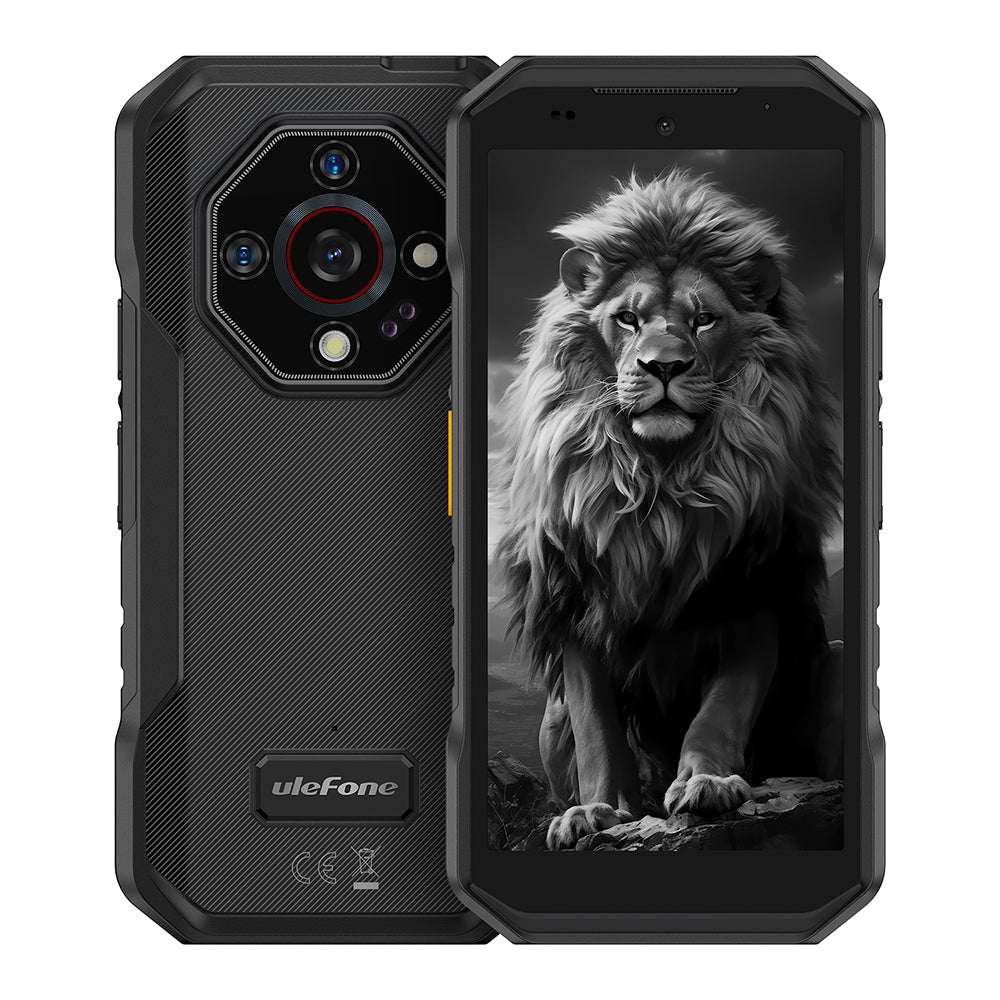
The standard body-worn handset for Nevtech VMS. A 280-gram rugged phone with a 6 nm SoC and a dedicated hardware H.264 encoder — chosen because it is the lightest device in its class that still carries LTE Band 71, and because every path the app depends on runs natively on it. We don't sell the hardware; buy it anywhere, install the app, and pair it in a minute.
Manufacturer-published figures. Two to verify on receipt: the OS batch (Android 14 or 15 — either runs the platform fully) and your carrier's actual certification.
Band lists abridged to the ones North-American fleets ask about; the full list is on the manufacturer's sheet. Carrier note: global-spec rugged phones are typically fine on T-Mobile, case-by-case on AT&T, and rarely certified on Verizon — verify one unit on your actual carrier and your actual account before a fleet purchase. That verification is a standing offer: send us your carrier and we'll test it with you.
Each capability the app depends on, against what the hardware actually provides.
| Platform requirement | Device provides | Fit |
|---|---|---|
| minSdk 26 / target SDK 35 | Android 14 (API 34) or 15 (API 35) | Native Camera, microphone and location foreground-service types are first-class on both. |
| Camera2 · hardware pipeline | Camera2 full · PDAF · HDR | Native No compatibility shims required. |
| Hardware H.264 · we never transcode | Dimensity 6300 encoder, 1440p30-capable | Headroom The 1080p15 profile uses roughly a quarter of the encode budget. |
| Evidence capture quality (band-exempt) | 64 MP IMX682 · 1/1.73" · f/1.9 | Strong A large sensor downsampling to 1080p is oversampling, not upscaling — real low-light headroom. |
| Talkback · radio semantics (v1.2.0+) | Rugged loudspeaker + 3.5 mm jack | Strong The jack also takes a wired lapel mic or earpiece for noisy scenes. |
| 20-second GPS breadcrumbs | GNSS + compass + gyro + accelerometer | Strong Barometer adds floor-level context in future work. |
| 1.5-second SOS hold | Gorilla Glass 5, glove-capable touch | Fit The hold gesture tolerates imprecise gloved contact. |
| Offline evidence buffer + hashing | 256 GB + dedicated microSD slot | Trivial The 2 GB dropout buffer is ~1.8 hrs of capture; the dedicated slot never costs the SIM tray. |
| Background survival | Near-stock Android, light OEM skin | Good One battery-optimization exclusion at provisioning; no Samsung/Xiaomi-class task killer. |
| Stealth screen dim | IPS LCD, backlit | Budgeted Stealth dim drops the backlight to a fraction of full-brightness draw, and the runtime table below already budgets the dimmed panel — so the shift figures hold as published. |
| Night-vision lens | 25 MP dedicated IR camera | Headroom Night shifts run on the main 64 MP sensor and its low-light headroom; the dedicated IR module is future app work. |
| End-of-shift bulk needs | Wi-Fi 5 · USB-C 2.0 | Plan for it Footage uploads during the shift, so there is normally nothing to dock — but a squad re-charging at 18 W takes 1.5–2 h, which is the practical argument for a spare unit per team. |
Typical draw at the standard 1080p15 H.264 profile with the screen dimmed — the profile the platform actually records at, on duty, all day.
| Draw component | Continuous capture | Event mode (buffering)* |
|---|---|---|
| Sensor + ISP @ 15 fps | 0.40 – 0.70 W | 0.35 – 0.55 W |
| H.264 hardware encode | 0.15 – 0.30 W | 0.10 – 0.20 W |
| App · hashing · file I/O | 0.25 – 0.45 W | 0.15 – 0.30 W |
| Flash writes | 0.05 – 0.15 W | ~0 W |
| Modem attached | 0.20 – 0.40 W | 0.05 – 0.15 W (sleeping) |
| GNSS breadcrumbs | 0.05 – 0.15 W | 0.05 – 0.15 W |
| Display, dimmed (IPS) | 0.15 – 0.35 W | 0.15 – 0.35 W |
| Total | 1.25 – 2.50 W | 0.85 – 1.70 W |
*Event mode is the armed-buffering mode described below — its column is here because the power case is part of why it exists: ~a third less draw, and the modem sleeps.
Coverage is a mounting decision, and it's one we make with you before the first unit goes on a vest.
The main lens sees roughly 67° horizontally (~80° diagonal). Add the 0.6× wide-angle converter we recommend for the mounting kit — a $15–40 optical part — and horizontal coverage moves to roughly 100–110°: commercial-bodycam territory, for the price of a lens cap.
Put the optic in the cradle, not on the phone. A cradle-integrated converter aligns itself every time the handset drops in — no clip to drift, vignette or get knocked loose mid-shift, and nothing for an officer to remember at the start of a tour. Ask us about mounting when you pilot and we'll spec the cradle and the optic against your vest.
The hardest failure in body-camera programs isn't equipment — it's activation. A Philadelphia compliance audit found footage missing in the large majority of encounters that required it, overwhelmingly from cameras never turned on, not cameras that failed. On this handset's own sensors: voice-fired SOS and spoken incident marks mid-shift, fall/shake detection from the accelerometer and gyroscope, and the armed mode — on-device sound classification for gunshot-family bangs, shouting, impacts, glass and doors, with a rolling two-minute pre-roll that saves the lead-up on every trigger. No holster sensor to buy, no vehicle kit, no per-sensor line item — the phone already contains the hardware. Full detail on the body-cameras page.
One phone, the app from our downloads page, your real account — and our standing promise to verify any model against the platform before you buy twenty.
Start a pilot How this compares to Axon →